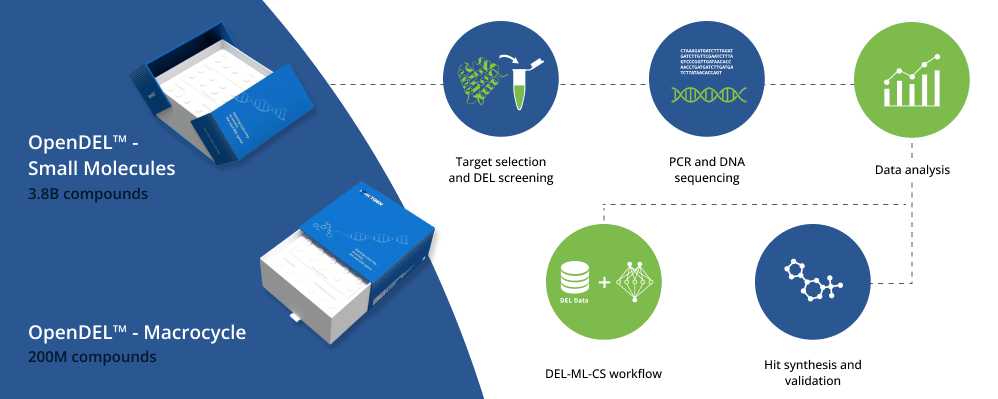
DNA-encoded chemical libraries (DELs) are a unique technology that combines benefits from both high-throughput screening and display technologies. The power of DEL lies in the ability to screen billions of small molecules in a single tube for interaction with a molecular target of interest. DNA-encoded libraries are collections of small molecules, where each of them are tagged with a unique DNA barcode. This concept combines organic synthesis with DNA encoding to create ultra-large compound libraries, enabling the screening of billions of molecules in a single experiment.
OpenDEL™
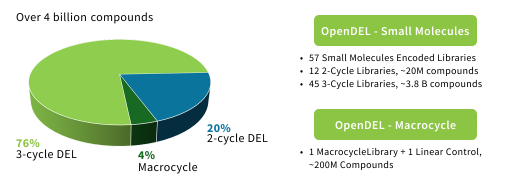
OpenDEL® is a self-serve product from HitGen OpenDEL® that contains small molecule DELs with high diversity and drug-like space and helps to increase the possibility of finding potential hits efficiently and cost-effectively.
It allows customers to explore the DEL campaign without sharing target information and saves money and time needed for a Drug Discovery campaign.
The advantages of OpenDEL®
1. All-ready and easy to use. A clear selection manual and all the key materials for selections are provided along with the OpenDEL® product. The only additional thing you need is your target!
2. No downstream obligation. No structure disclosure fee or license fee for the hits discovered.
3. Open. Customers can analyze the SAR trend or run AI-ML using shared building blocks and codon information.
4. Private. You don’t share your target information – intellectual property is protected.
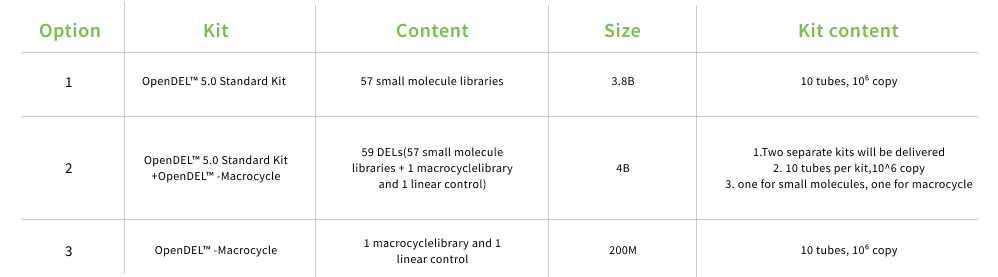
The product includes the standard selection protocol and all the necessary materials for molecules selection.
DEL-ML-CS
Explore service that combines DNA-encoded libraries (DEL), Machine learning (ML), and large chemical spaces (CS) to speed up the discovery process and reduce its cost while maintaining a high hit rate.
The data after the DEL screen is carefully processed, and this data is used for machine learning. This model can be applied to search in combinatorial chemical spaces up to 300B compounds (including Enamine REAL 80B and Chemspace Freedom 142B), utilizing our in-house algorithms.