Freedom Space 5.0

Theoretical chemical space contains around 10⁶⁰ small molecules. But the real question is not what is theoretically possible, but what is actually useful. That is where commercial chemical spaces come in. They map the molecules we can realistically synthesize from available building blocks and known chemistry. For drug discovery teams, they have become the starting point - a way to explore billions of structures computationally before committing time and resources to synthesis.
But a bigger catalog does not guarantee better results. What matters is whether a chemical space consistently delivers relevant, diverse, and accessible chemistry when you need it. That is what Freedom Space is built for, and with version 5.0, we have taken it further. Each version of Freedom Space has pushed us to rethink how we build it. The goal has always been the same: create chemistry that is actually synthesizable, diverse, and biologically relevant - qualities that sound obvious but are surprisingly hard to deliver at scale.
Freedom Space 5.0 reflects years of learning what works in real discovery workflows, whether you are hunting for initial hits, expanding around a scaffold, or optimizing leads.
Why Freedom Space?
Freedom Space 5.0 was designed to address the core challenges that limit most chemical spaces: ensuring synthetic feasibility, maximizing structural diversity, maintaining biological relevance, and enabling efficient exploration at scale.
- Over 80% synthesis success rate (experimentally confirmed)
- 215K+ building blocks from 15 most trusted suppliers were used for space creation
- 39 synthetic protocols (2 and 3-component reactions) for subsets enumeration
- 5-6 weeks lead time, including the synthesis process
- Close to 0% overlap with Enamine REAL Space
- Created using ML models trained on real data
Access Options
Freedom Space 5.0 is available for exploration on both our own platform and our computational chemistry partners' platforms.




Freedom Space Subsets
Freedom Space 5.0 is available through ready-to-download enumerated subsets, each of which contains 5 billion fully expanded molecules. Three collections are offered: a subset compliant with Lipinski's Rule of Five (Ro5) for traditional drug-like chemical space, a Beyond Rule of Five (bRo5) subset for exploring larger and more complex molecules, and a randomly selected subset representing the full structural diversity of Freedom Space. In addition, three Freedom Sample Sets are available, containing 0.1%, 1%, and 10% of the corresponding Freedom Space subsets. These smaller, representative datasets help researchers test workflows, assess computational requirements, and scale up screening according to their available resources.
5B Rule of 5
Drug-like subset for large-scale virtual screening of orally bioavailable small molecules. Compounds meet Lipinski's Rule of Five (Ro5), making the dataset suitable for classical medicinal chemistry workflows, hit identification, and AI model training.
5B Beyond Rule of 5
Subset for larger and more complex molecules relevant to protein–protein interactions (PPIs), macrocycles, PROTAC-like compounds, and peptidomimetics. Designed for targets where classical Ro5 libraries are often insufficient, this subset opens access to broader chemical space.
5B Diversity
The broadest cross-section of Freedom Space 5.0, created without physicochemical filters. This subset is well suited for chemical space exploration, diversity-based screening, active-learning workflows, and projects where standard drug-likeness rules are intentionally not applied.
Focused Subsets
Focused subsets are compound collections selected from Freedom Space 5.0 to support screening workflows, each defined by a specific selection strategy — physicochemical filters, similarity, or substructure matching — and application-specific discovery goals.
| Name | Size | Description | Download |
|---|---|---|---|
| Lead-like subset | 100M |
Molecules selected for lead-oriented screening, hit optimization, and further structural growth. The subset focuses on compounds with sufficient room for further optimization — molecular weight increase, lipophilicity tuning, and scaffold development.
MW ≤ 350 Da
LogP ≤ 3
HBD ≤ 3
HBA ≤ 6
RotB ≤ 7
|
Download |
| Fragments subset (Rule of 3) | 12M |
Low-molecular-weight molecules selected for fragment-based screening, hit expansion, and early-stage library design. The subset focuses on compact structures with controlled polarity, a low count of hydrogen-bond donors and acceptors, and limited molecular flexibility.
MW < 300 Da
SlogP ≤ 3
HBA ≤ 3
HBD ≤ 3
RotB ≤ 3
TPSA ≤ 60
|
Download |
| Natural-like subset | 100M |
Molecules selected on the basis of predicted natural product-likeness (NP-likeness), calculated using the approach published by Ertl et al. (J. Chem. Inf. Model. 2008, 48 (1), 68–74; DOI: 10.1021/ci700286x). The subset focuses on drug-like structures with positive NP-likeness scores, capturing the scaffold complexity and structural features characteristic of natural products while remaining synthetically accessible.
NP-likeness 0–5
|
Download |
| CNS-targeted subset (BBB-penetrable molecules) | 100M |
Molecules selected for central nervous system (CNS) drug discovery and screening against brain targets. The subset focuses on compounds with the physicochemical profile of drugs that cross the blood–brain barrier (BBB) — controlled molecular weight and polarity, low hydrogen-bond donor count, and balanced lipophilicity. Selection is further refined with SMARTS filters for basic and acidic groups and for BBB permeability.
MW ≤ 450 Da
LogP 1–4
HBD ≤ 1
HBA ≤ 6
RotB ≤ 8
TPSA 40–90
SMARTS filters (basic/acidic groups, BBB)
|
Download |
| Agro subset | 5M |
Molecules selected for agrochemical lead discovery and analog-based exploration of known active compounds. The subset focuses on close analogs of validated agrochemical scaffolds, retrieved from the Freedom Space synthon space using FTrees and SpaceLight similarity searches, broadening chemical coverage around each reference compound while retaining its defining structural features. Selection is similarity-driven only, with no property cutoffs applied. |
Download |
| Molecular glue subset | 615M |
Molecules selected for molecular-glue discovery against cereblon (CRBN). The subset focuses on compounds carrying CRBN-binding recognition motifs, curated to engage the cereblon surface and captured through SMARTS substructure matching across a validated panel of chemotypes. Selection is structure-driven, with no property cutoffs applied, providing a focused starting pool of candidate molecular glues for CRBN-directed screening. |
Download |
Covalent Subsets
Representative electrophile classes for covalent hit discovery. Each subset is defined by a specific warhead class with a well-characterized reactivity profile toward nucleophilic protein residues, enabling focused screening for targeted covalent inhibitors (TCIs).
| Name | Size | Description | Download |
|---|---|---|---|
| Acrylamides | 100M |
The most widely used covalent warhead, reacting with cysteine via Michael addition. |
Download |
| Chloroacetamides | 96K |
A more reactive electrophile, alkylating cysteine via an SN2 mechanism. |
Download |
| Butynamides | 11M |
An alkyne-based warhead, reacting with cysteine, lysine, and histidine via Michael-type addition. |
Download |
Create Your Own Chemical Space
To explore previously unknown regions of chemical space, we at Chemspace developed an algorithm for creating a custom chemical space. Such space can include the building blocks from the proprietary building block collection or a custom list of suppliers. Chemspace covers all critical aspects: full IP protection and confidentiality, regular space updates based on building block availability, and access to both enumerated and fragment versions of your space.
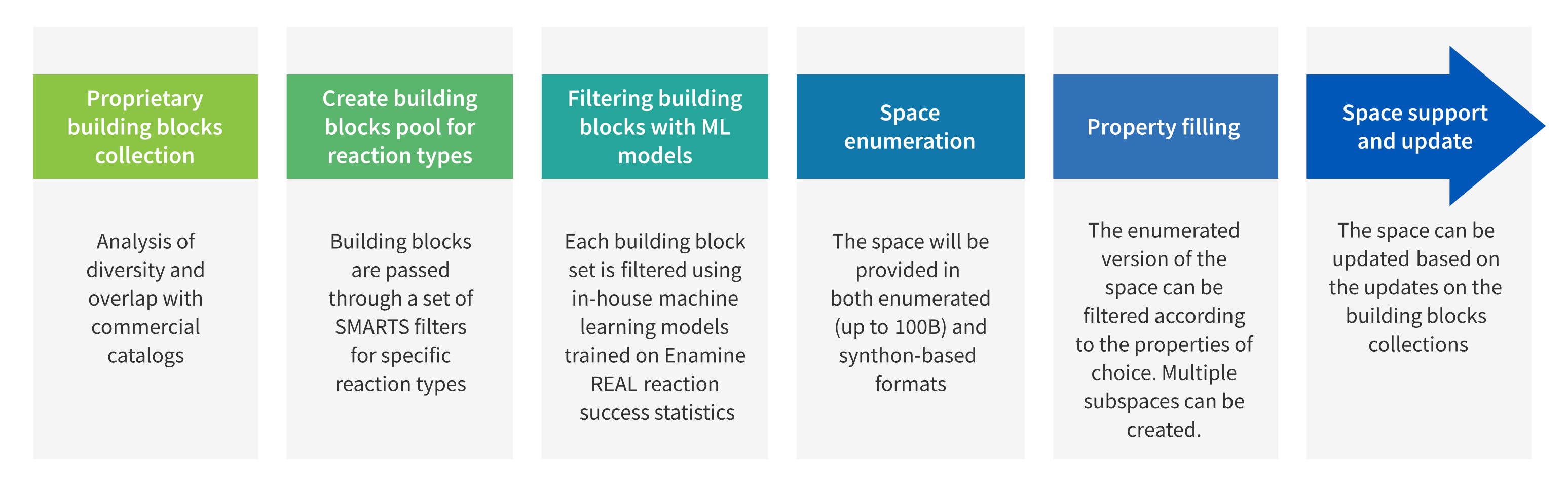
For the enumeration step, there are two options. We can enumerate a custom chemical space using only your
proprietary building block collection. Alternatively, we can combine your proprietary building blocks with
Enamine's collection to create a more diverse custom chemical space. In the combined approach, at least one
building block in each final molecule must be proprietary, ensuring your library maintains unique chemical
matter.
We also provide synthesis services for selected compounds from your generated custom space. If
you
are interested, contact us, and our manager will reply shortly.
What is Freedom Space 5.0?
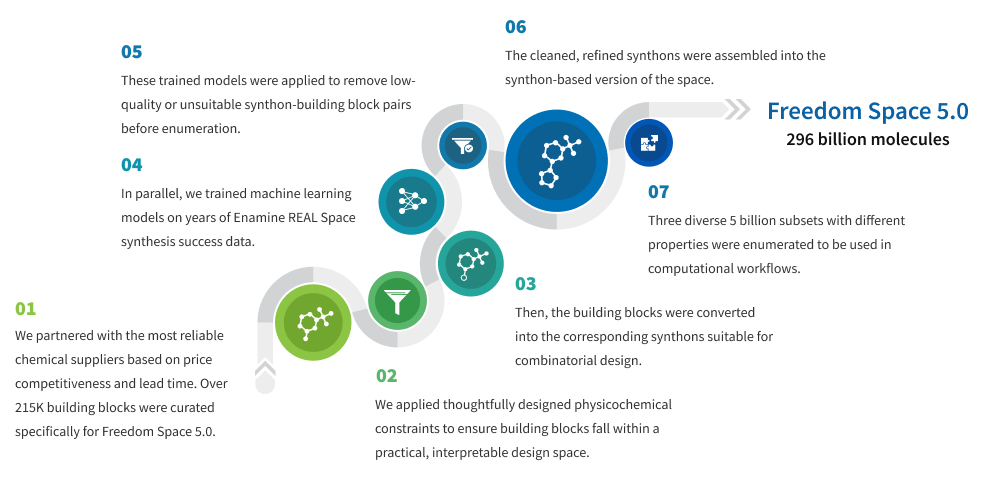
Freedom Space is an ultra-large, synthetically accessible chemical space containing over 296 billion molecules. Developed by Chemspace using proprietary machine learning algorithms, this synthon-based library was specifically designed to accelerate early drug discovery by solving a critical challenge: ensuring that virtual screening hits can actually be synthesized.
Most chemical libraries generate structures first and hope they are synthesizable. Freedom Space does the opposite. We use ML models to evaluate building blocks for synthetic feasibility before creating the library. This means the hits you identify are already connected to validated chemistry and available starting materials - not theoretical compounds that fail in the lab.
Why Chemical Spaces Matter in Drug Discovery
Drug discovery is essentially a search problem across an impossibly large universe of molecules. Physical screening libraries get you a few million compounds - chemical spaces let you explore billions computationally. The real value isn't just scale, though. Modern chemical spaces connect virtual hits directly to synthesis, so when you identify a promising structure, you can immediately explore thousands of makeable analogs instead of hoping your vendor has something close. For AI-driven discovery, they provide the diverse training data needed for reliable predictions. And critically, well-designed spaces like Freedom Space prioritize synthetic feasibility from the start, which means fewer dead ends where hits look great on paper but fail in the lab. Chemical spaces transform discovery from "screen what exists" to "design what you need" - and that shift is why hit-to-lead timelines keep getting faster.
Available Space Formats & Access Methods
Freedom Space 5.0 is available through our partners' screening platforms.
BioSolveIT. You can explore Freedom Space 5.0 using the infiniSee platform developed by BioSolveIT. infiniSee enables rapid similarity searches, substructure queries, and pharmacophore-based screening across billions of compounds without requiring full enumeration. The platform combines powerful search algorithms with interactive visualization tools, allowing medicinal chemists to efficiently identify structurally diverse analogs and navigate chemical space at scale. Perfect for hit identification, scaffold hopping, and lead optimization workflows.
Alipheron. Pharos-3D is a novel computational 3D-similarity search method that leverages and combines 3D shape and pharmacophore models for the efficient virtual screening of ultra-large combinatorial spaces (ULCS). It integrates low-energy conformer shape matching with an analysis of potential protein interactions.
HyperSpace is Alipheron's ultra-fast 2D virtual screening tool for searching trillions of make-on-demand compounds using substructure queries and similarity searches. It supports advanced query features, including aromatic specifications, ring constraints, excluded substituents, and flexible linkers, enabling everything from precise analog searching to scaffold hopping. Typical searches return thousands of matching molecules in under a minute.
Key Benefits of Freedom Space
Freedom Space 5.0 was designed to address the core challenges that limit most chemical spaces: ensuring synthetic feasibility, maximizing structural diversity, maintaining biological relevance, and enabling efficient exploration at scale.
Synthetic Feasibility. With an over 80% experimentally confirmed synthesis success rate, Freedom Space delivers chemistry that actually works in the lab. We used machine learning models trained on the reaction success data from Enamine to ensure every compound is grounded in validated synthetic protocols.
Curated for Diversity and Quality. Built from 215K+ novel building blocks sourced from the most trusted suppliers, Freedom Space explores chemical territory that's both structurally diverse and biologically relevant. ML models trained on real synthesis data guide building block selection, ensuring each molecule meets drug discovery standards before entering the space.
Unique Chemical Matter. Close to 0% overlap with Enamine REAL Space means Freedom Space opens access to distinct chemical territory - ideal for exploring novel scaffolds, avoiding crowded IP space, or finding differentiated starting points for your programs.
Frequently Asked Questions
How can I download Freedom Space data?
How quickly can compounds be supplied?
What is a synthetically accessible chemical space?
What data do you provide with delivered compounds?
What are the licensing options?
Do you provide enumerated libraries for virtual screening?
- Kapeliukha, A.; Hlotov, S.; Protopopov, M.; Dzyuba, I.; Vasylchuk, M.; Panov, D. M.; Tarkhanova, O. O.; Moroz, Y. S. Freedom Space 3.0: ML-Assisted selection of synthetically accessible small molecules. Journal of Chemical Information and Modeling 2025, 65 (19), 10338–10347. https://doi.org/10.1021/acs.jcim.5c01912