The search for new medicines has always been, at its core, a process of exploring chemical diversity. Every approved therapy represents a specific molecular choice among countless alternatives that could have been pursued. Yet the number of possible small organic molecules is so vast that it dwarfs our ability to synthesize or even imagine them all. This almost unfathomable universe of conceivable compounds is what scientists refer to as chemical space.
What Is Chemical Space?
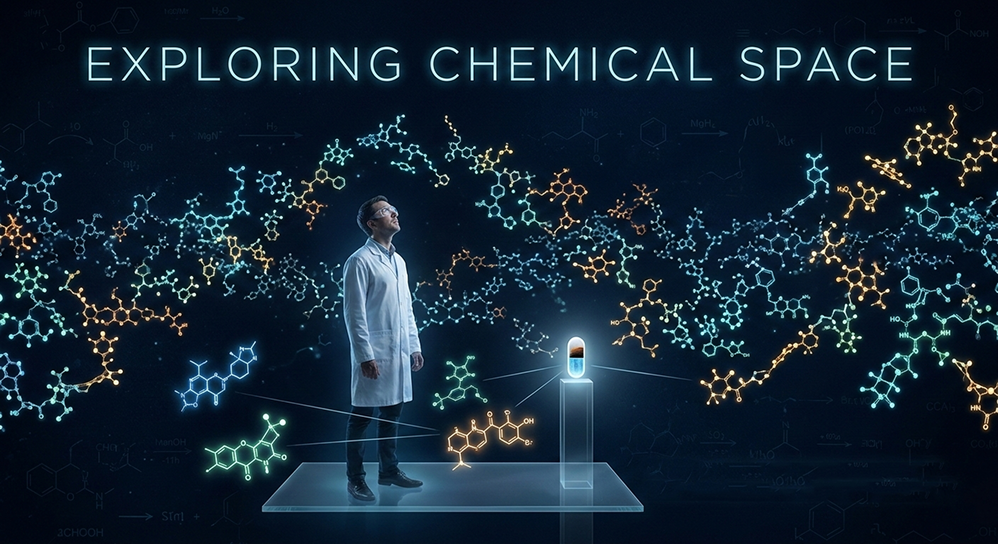
Chemical space is a representation of all possible (real or hypothetical) chemical compounds, characterized by their structural and physicochemical properties. Each molecule can be represented as a point in this space, positioned according to descriptors such as molecular weight, polarity, topology, functional groups, and three-dimensional shape.
The size is staggering: the number of theoretically possible structures has been estimated to exceed 10⁶⁰. Only a tiny fraction of these have ever been synthesized or tested.
Chemical space is therefore both a map and a reminder of limitations. It shows that the known molecules occupy only a small island in an ocean of potential chemistry. The challenge is not to cover the entire ocean, which is impossible, but to explore it intelligently. Somewhere within these unexplored regions may lie molecules capable of treating currently incurable diseases.
The Role of Chemical Space in Drug Discovery
Biological activity is inherently linked to molecular structure. Subtle differences in three-dimensional arrangement, electronic distribution, or functional group orientation can dramatically alter binding affinity and selectivity. For this reason, chemical space in drug discovery is not simply about quantity; it is about meaningful diversity.
Historically, drug discovery often progressed through incremental optimization of known scaffolds. While this approach produced many successful therapies, it also concentrated effort within relatively limited molecular regions. Over time, such clustering can limit innovation and increase competition around similar intellectual property landscapes.
In contrast, modern drug discovery increasingly emphasizes strategic diversity. Computational modeling, virtual screening, and machine learning allow researchers to analyze vast datasets and identify underexplored structural domains. Rather than repeatedly modifying familiar cores, research teams can deliberately expand into new molecular territories.
This shift reflects a practical reality: emerging biological targets frequently require novel chemistry. Without sufficient exploration of chemical diversity, the probability of identifying differentiated mechanisms of action remains constrained.
Traditional Compound Libraries and Their Limitations
For decades, drug discovery research relied on traditional compound libraries as physical screening collections. These libraries, built from internal synthesis programs, collaborations, and commercial suppliers, were often biased toward specific scaffolds and chemistries shaped by historical synthetic practices and available building blocks.
While such collections enabled many breakthroughs, they also imposed invisible boundaries on what could be discovered. The overwhelming majority of drug-like chemical space remains unexplored simply because the molecules were not physically available for testing.
Another limitation lies in redundancy. Many traditional libraries are overcrowded in some areas of chemical space, with thousands of similar analogues competing for the same biological targets. This reduces the effective diversity of screening efforts, as hits tend to cluster around familiar chemotypes. As researchers pursue more complex biological targets, these coverage gaps become increasingly apparent. The recognition of these limitations has fueled interest in comprehensive, systematic chemical space exploration.
Exploring and Mapping Chemical Space
Advances in cheminformatics have transformed how scientists conceptualize chemical diversity. Molecular descriptors, fingerprints, and dimensionality-reduction algorithms enable the projection of high-dimensional data into interpretable visual maps. These maps enable researchers to identify dense clusters of well-characterized chemistry as well as sparsely populated regions that may represent opportunities.
Mapping is only the first step. Predictive modeling and machine learning enable researchers to evaluate biological relevance, synthetic feasibility, and drug-likeness across vast virtual libraries. Instead of synthesizing compounds at random, teams can prioritize candidates located in purposefully selected regions of chemical space.
Importantly, chemical space exploration is iterative. Scientists use experimental results to refine computational models, which, in turn, guide further exploration. Over time, this feedback loop allows for increasingly precise navigation of molecular landscapes.
Effective exploration, therefore, combines analytics, synthetic innovation, and strategic curation. Researchers conduct this as a disciplined process rather than an indiscriminate expansion.
Why Chemical Space Coverage Matters in Modern Drug Discovery
Effective coverage of chemical space directly influences the success of hit finding during the drug discovery process. If screening libraries sample only restricted regions, entire classes of potential therapeutics may be overlooked. More comprehensive, rational coverage increases the likelihood of identifying novel mechanisms of action and compounds with improved safety profiles.
In modern drug discovery, where timelines and budgets are under constant pressure, efficient exploration matters as much as breadth. Strategic coverage reduces wasted effort on redundant chemistries and focuses resources on higher-potential areas. It also supports innovation by encouraging movement beyond well-trodden scaffolds.
Importantly, coverage does not mean randomness. It means deliberate distribution across relevant regions of chemical space, informed by biological knowledge and predictive analytics. When done well, it creates a foundation for sustained discovery rather than one-off successes.
From Concept to Practice: Curated and Expanded Chemical Spaces
Turning the concept of chemical space into practice requires infrastructure. Modern chemical platforms aggregate billions of purchasable compounds, enabling structural searches, filtering, and candidate prioritization.
Curated chemical spaces focus on subsets relevant to specific tasks, such as fragment libraries, covalent inhibitors, target- or disease-oriented molecules, etc. Expanded spaces push further, incorporating virtual compounds that can be synthesized on demand. This blend of real and virtual chemistry dramatically increases the accessibility of diversity.
An example is the Freedom Space, which represents a large, curated, and searchable collection of synthetically accessible molecules. By combining marketplace access with computational filtering, such initiatives translate chemical space from theory into an actionable resource.
Ultimately, the question is not only what chemical space is, but how effectively we can navigate it. As tools for modeling, synthesis, and data integration continue to evolve, the boundaries of accessible chemical space expand. In that expansion lies the promise of discovering the next generation of medicines.