Ultra-large chemical spaces are often discussed in terms of size. In practice, the harder question is more operational: when integrated into real discovery workflows, can a space consistently retrieve chemistry that is relevant rather than merely abundant.
A recent benchmark by Alexander Neumann and Raphael Klein at BioSolveIT probed multiple large commercial chemical spaces with known bioactive molecules, focusing on practical performance: bioactive coverage, analog diversity, and search behavior at scale using established similarity and substructure methods.
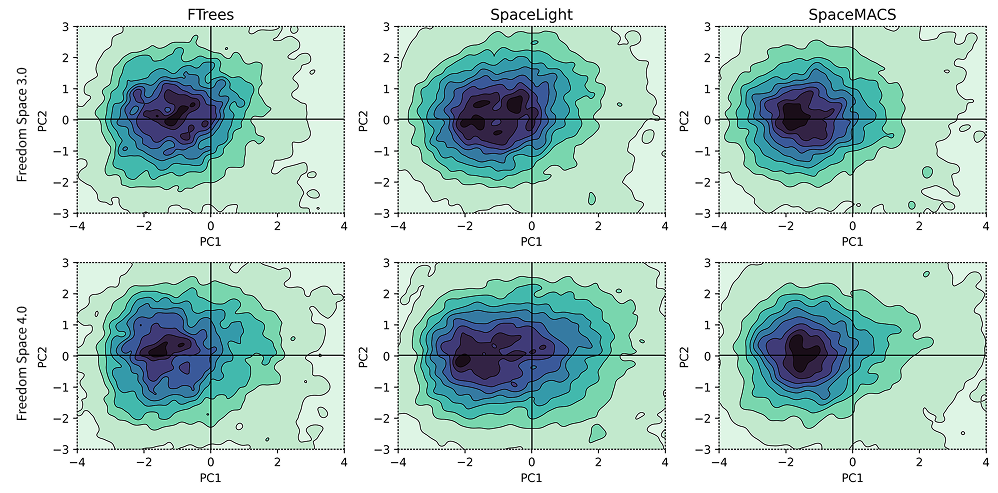
That study included our Freedom Space 3.0 alongside other large commercial chemical spaces. Using the same benchmark framework, we repeated the analysis on Freedom Space 4.0, which incorporates a larger and more diverse set of reactions as well as compounds that fall in the beyond rule of 5 property range.
Key results:
▪️ Broader coverage of more polar and functionally rich regions of the benchmark set, while remaining within commonly used drug-like property envelopes.
▪️ Improved access to structurally complex and branched analogs relative to Freedom Space 3.0, particularly in regions underrepresented before.
▪️ Higher apparent diversity in retrieved analog sets across FTrees, SpaceLight, and SpaceMACS searches, without a loss in analog relevance.
As chemical spaces evolve, benchmarking their practical behavior remains essential to keeping scale aligned with discovery needs.
We thank the authors for establishing a clear, practice-driven benchmarking framework: https://doi.org/10.1021/acs.jcim.5c00719.