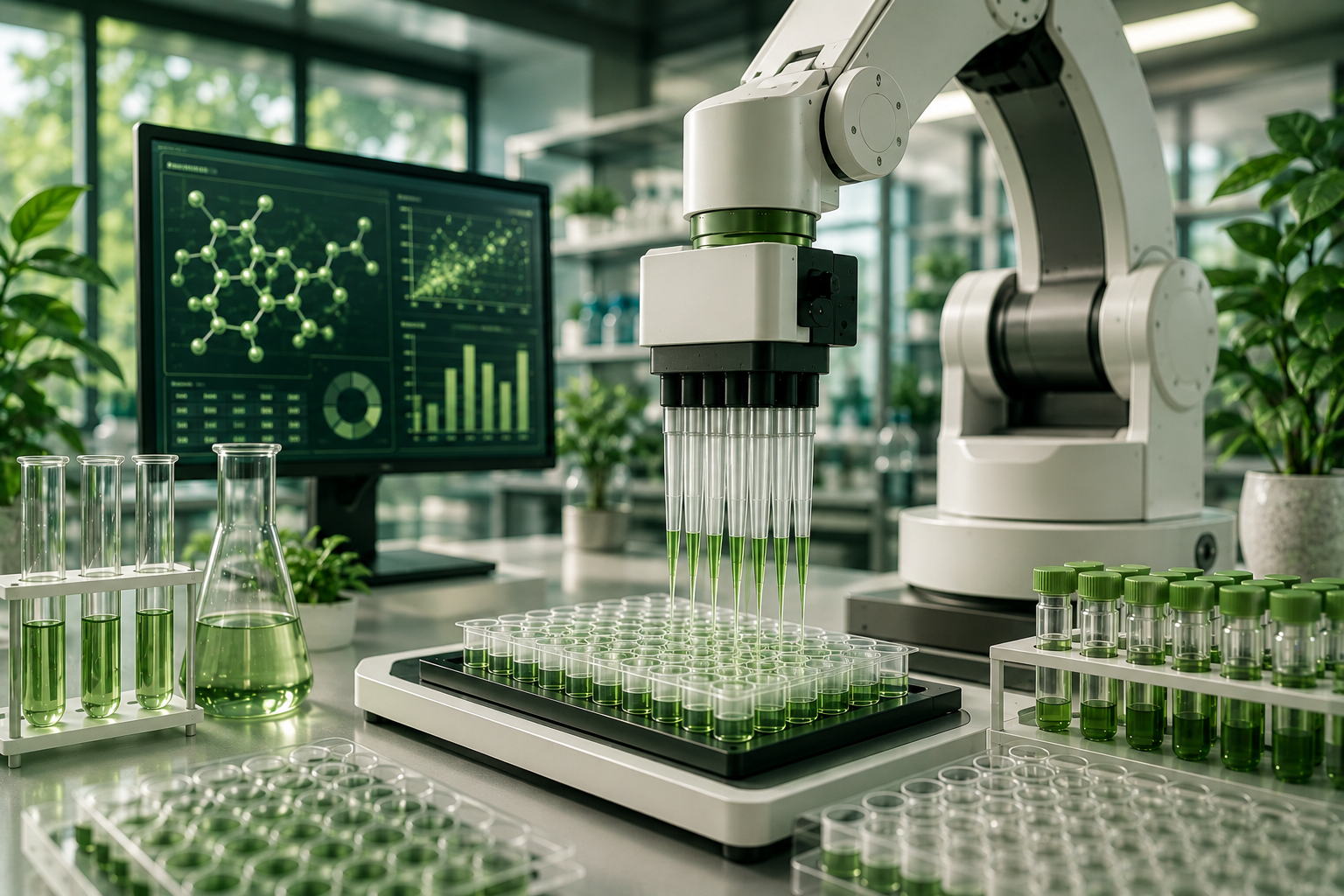
Drug discovery is a constant race against time, cost, and biological uncertainty. To succeed, research teams need not only strong scientific insight but also speed, reproducibility, and the ability to scale experiments efficiently. This is why automation has become a core component of R&D strategy. Today, automation solutions for drug discovery go far beyond robotics: they reshape how laboratories generate data, manage experiments, and make decisions across the discovery workflow.
In practice, automation enables research teams to run more experiments with fewer errors while maintaining consistency across multiple assay formats. It reduces variability caused by manual handling and enables faster DMTA (Design-Make-Test-Analyze) cycles. For many organizations, drug discovery automation solutions are no longer a competitive advantage – they are a requirement for staying efficient and scientifically reliable.
What Is Automation in Drug Discovery?
At its most basic, drug discovery automation means using robotic systems, integrated instruments, and software to perform laboratory tasks with reduced manual intervention. This can mean a single liquid handler that replaces manual pipetting, or a fully integrated platform where compound retrieval, sample preparation automation, assay execution, and data transfer happen in sequence without a researcher touching anything between steps.
The distinction between automating a task and automating a workflow matters. Replacing a manual pipetting step with a robot saves time on that step. Connecting compound dispensing, incubation, plate reading, and data logging into a continuous, managed sequence eliminates the coordination overhead between steps, reducing variability and delays. Automation solutions for drug discovery at the workflow level deliver compounding gains that single-instrument automation cannot.
Where Drug Discovery Automation Is Used
Automation appears at every major stage of drug discovery, though its form varies considerably depending on the experimental demands of each phase. The four areas below represent where it has had the most consistent impact.
Target identification and validation
Identifying which protein or pathway to target requires processing large volumes of genomic, proteomic, and phenotypic data. Automated bioinformatics pipelines handle this at a scale that manual analysis cannot approach. Validation – confirming that a target is causally involved in disease, rather than merely correlated with it – relies on cell-based and biochemical assays across many conditions. Automated platforms manage plate preparation, compound addition, incubation, and readout for these experiments, producing reproducible datasets that support or refute target hypotheses with statistical confidence.
Compound screening and hit identification
High-throughput screening is the application most directly associated with automated screening in drug discovery. HTS campaigns test hundreds of thousands of compounds against a biological target, each at multiple concentrations, often in duplicate. This is not feasible manually – throughput would be measured in hundreds of compounds per day rather than tens of thousands.
Robotic liquid handling systems sit at the center of these campaigns, dispensing precise nanoliter-to-microliter volumes of compounds and reagents into high-density plates with consistent timing across every well. Modern acoustic dispensers can transfer compounds in droplets as small as 2.5 nanoliters – a precision level that eliminates solvent volume as a confounding variable and significantly reduces reagent consumption.
Lead optimization and assay iteration
Once a hit series is identified, the focus shifts to understanding and improving the structure-activity relationships that govern potency, selectivity, and physicochemical properties. The speed of turnaround matters more than raw throughput here. Relatively speaking, a compound synthesized on Monday needs cellular data by Wednesday for the medicinal chemist to make synthesis decisions the following week. Assay automation makes that cycle realistic by handling compound formatting, plate preparation, and execution in hours rather than days, removing the queue between chemistry and biology.
Data capture, workflow orchestration, and quality control
High-volume screening generates data faster than any manual process can manage. Automated data capture systems pull results directly from instruments into structured databases, eliminating transcription errors and enabling immediate downstream processing. A laboratory information management system (LIMS) connects these streams across instruments and experiments, tracking sample provenance, reagent lots, assay versions, and instrument status in one searchable repository. Automated QC flags plates where control values fall outside acceptance criteria before compound data is analyzed – preventing failed runs from generating misleading hits.
Core Technologies Behind Drug Discovery Automation
The hardware and software behind lab automation for drug discovery span a wide range, but a few categories account for most of the operational impact.
Robotic liquid handling platforms range from benchtop single-channel dispensers to multi-arm workcells that manage compound storage, plate copying, and reagent addition in parallel. Integrated plate readers – covering fluorescence, luminescence, absorbance, and high-content imaging – connect to liquid handlers through scheduling software and robotic plate movers, enabling unattended overnight runs across hundreds of plates.
Compound management systems automate the storage, retrieval, and reformatting of chemical libraries, maintaining sample integrity and tracking tube and plate locations across a campaign. Workflow automation software orchestrates the full sequence: scheduling instrument tasks, managing step dependencies, logging every action in an auditable format, and surfacing exceptions for human review without requiring human oversight of routine execution.
Benefits and Challenges of Automation in Drug Discovery
The gains from automation are consistent. Throughput increases are the most visible: a single integrated platform can screen more compounds in a week than a manual team could manage in months. Reproducibility improves because mechanical systems apply the same parameters to every well on every plate, removing operator-dependent variability, a recognized contributor to non-reproducibility in biomedical research. Data quality improves because automated capture creates complete, time-stamped records of every experimental parameter, supporting both scientific interpretation and regulatory review. Automation can also reduce laboratory risk by limiting human exposure to hazardous materials. This allows scientists to focus more on experimental design and interpretation.
The challenges are practical. Capital costs for integrated laboratory automation platforms are substantial, and the return on that investment depends on sustained high utilization. Organizations that automate infrequently find that validation, maintenance, and training overhead outweighs efficiency gains. Skilled personnel are also required – setting up and troubleshooting automated workflows requires expertise different from traditional bench science. Flexibility is a real constraint: automated systems perform defined protocols well, but novel experiments that fall outside established procedures often still require manual execution, at least initially.
How Automation and AI Work Together in Drug Discovery
Automation generates experimental data at scale. AI turns that data into predictions that guide the next round of experiments. The pairing is not coincidental – Machine Learning-based Services in drug discovery require large volumes of high-quality, consistently formatted data to train on, and automated platforms are the most reliable way to produce it.
In practice, the integration runs in both directions. Models trained on screening data predict which untested compounds from a virtual library are most likely to show activity, allowing computational prioritization before physical testing. Those compounds are then tested on automated platforms, generating new data that refines the model’s next predictions. This closed loop – predict, test, learn – is the defining architecture of modern AI-assisted lead optimization, and it only functions if the experimental side of the loop runs fast enough to keep pace with the computational side.
High-content imaging is another area where the combination is transformative. Automated imaging platforms generate millions of cell images per experiment; machine learning models classify cells, detect phenotypic changes, and identify morphological signatures of target engagement or toxicity that no human reviewer could find at that scale. The combination makes phenotypic screening at HTS throughput genuinely practical. Integrated drug discovery services that combine automated experimental execution with computational analysis deliver both capabilities within a single workflow, which is increasingly what research organizations require.
Future Trends in Drug Discovery Automation
The near-term trajectory of automation in drug discovery points toward greater integration across platforms, more AI-driven decision-making within workflows, and a broader range of biological models handled in automated formats.
Self-driving laboratories – where AI systems design experiments, automated hardware executes them, and machine learning models interpret results and propose the next round without human input between cycles – are moving from isolated proof-of-concept installations toward practical adoption. Several academic and commercial platforms already offer fully automated execution of standard assay panels, accessible remotely through software interfaces. As the range of automatable protocols expands and the AI systems directing them mature, the boundary between what requires human judgment and what can run autonomously will shift further.
Three-dimensional cell culture models, including organoids and organ-on-a-chip devices, are increasingly integrated into automated screening workflows. These formats offer more physiologically relevant data than monolayer cultures but are harder to prepare and analyze at scale. Advances in automated dispensing and image analysis are making routine use feasible. For organizations building drug discovery automation solutions today, the practical challenge is not whether to automate but how to build workflows that remain flexible enough to incorporate these more complex models as the field’s standards for biological relevance continue to rise.
Thus, automation is no longer an optional upgrade – it is becoming the backbone of modern drug discovery. By enabling automated screening, scalable experimentation, and consistent data generation, automation helps laboratories make faster and more confident decisions. As AI-driven methods continue to evolve, automation will remain central to the future of pharmaceutical innovation, turning complex discovery workflows into structured, efficient, and reproducible pipelines.